2 The Jump To University
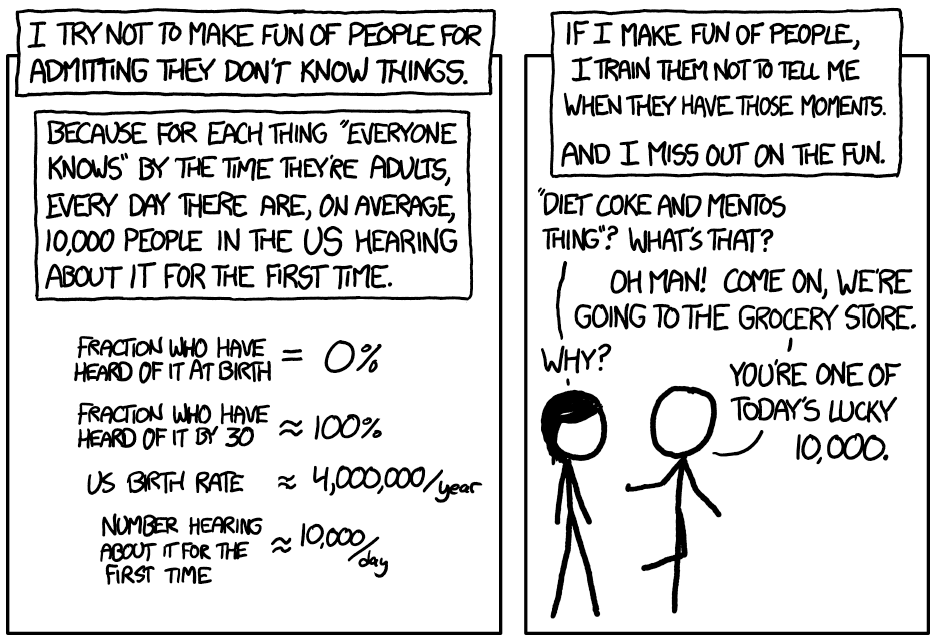
I was born not knowing and have only had a little time to change that
Richard P. Feynman
2.1 The Mindset Shift
At school, I became used to understanding things quickly. If I didn’t understand something in class, I could by the end of the lesson. And if I didn’t, I could do a couple questions and it would click. University maths felt different almost immediately.
Having worked at department offer holder days, one of the most common questions I get asked is: ‘What’s the jump actually like? Is it just harder? Is it just more content?’
My honest answer has been, and still is: it’s just different.
2.2 What Actually Changes
The most noticeable change is that you don’t understand things straight away. I remember hearing this at open days but I don’t think I understood this until experienced it firsthand.
At school, not understanding meant you needed more practice. University requires need more time, reflection, even different way of thinking about the problem. This can be particularly difficult if you’re used to being ‘the maths person’, or the one who usually gets it first, so change isn’t just academic, it’s psychological.
In many subjects or courses, you can revise by memorising key ideas, reading around the topic or absorbing information repeatedly until it sticks. Mathematics doesn’t work like that. You can’t (always) memorise your way into deep understanding or skim a proof and expect it to feel natural. You can’t treat definitions as just some vocabulary words and hope they’ll make sense.
2.3 Redefining Understanding
If you ever feel confused or find yourself struggling, rest assured, you’re not alone. It’s incredibly common, normal, and all part of the process. A lot of the difficulty comes not from the material itself, but from the expectations you might place on yourself.
Mathematics is a conceptually difficult subject. If you approach each lecture or assignment with the mindset that you’re expected to understand everything, or feeling confused means you’re not good enough, the delay or lack of those things can feel like failure.
The challenging part is letting go of the need to understand everything immediately. This doesn’t mean lowering standards, but adjusting expectations. Understanding at this level takes time and sitting with ideas that don’t immediately make sense, as well as trying approaches that don’t work and getting used to not always being the fastest or most confident in the room.
2.3.1 For When Your Brain Just Isn’t Working
The lecturer is speaking, and the words are technically English, and the notation seems familiar. The content might not even be complicated, and yet, nothing seems to land. You realise you’ve copied half a page without actually processing a single line and catch yourself been thinking about what you’re going to have for lunch for the last 8 minutes.
This is normal and happens to the best of us. It does not mean you have suddenly lost the ability to think mathematically. Engaging with university mathematics requires sustained concentration in a way that school rarely did. The abstraction is higher and the cognitive load is heavier. Your brain will sometimes hit its limit, especially if you’re tired, stressed, slightly underslept, or just adjusting to a new routine and environment.
Not every lecture will feel inspiring and not every topic will immediately excite you. On days when your performance is nowhere near optimal, lower the bar slightly. Pick one line or sentence on the board and ask yourself what it is actually saying. Or write down one question you would ask if you were brave enough, or underline one step in the proof that feels unclear and mark it to revisit later. Just write a short sentence that summarises what you have learned so far, or questions if you’re confused about something. Small physical adjustments often help reset focus more than you’d expect.
And if you’re brain truly isn’t cooperating despite your best efforts, just accept that for what it is. Stay present as best you can, then review the material later when you’re more alert.
The key message here being, one unfocused lecture does not define your trajectory1. Boredom, distraction, fatigue- it’s all part of the learning experience, and learning to work with them rather than against them is part of becoming a good learner.
Pun intended↩︎